






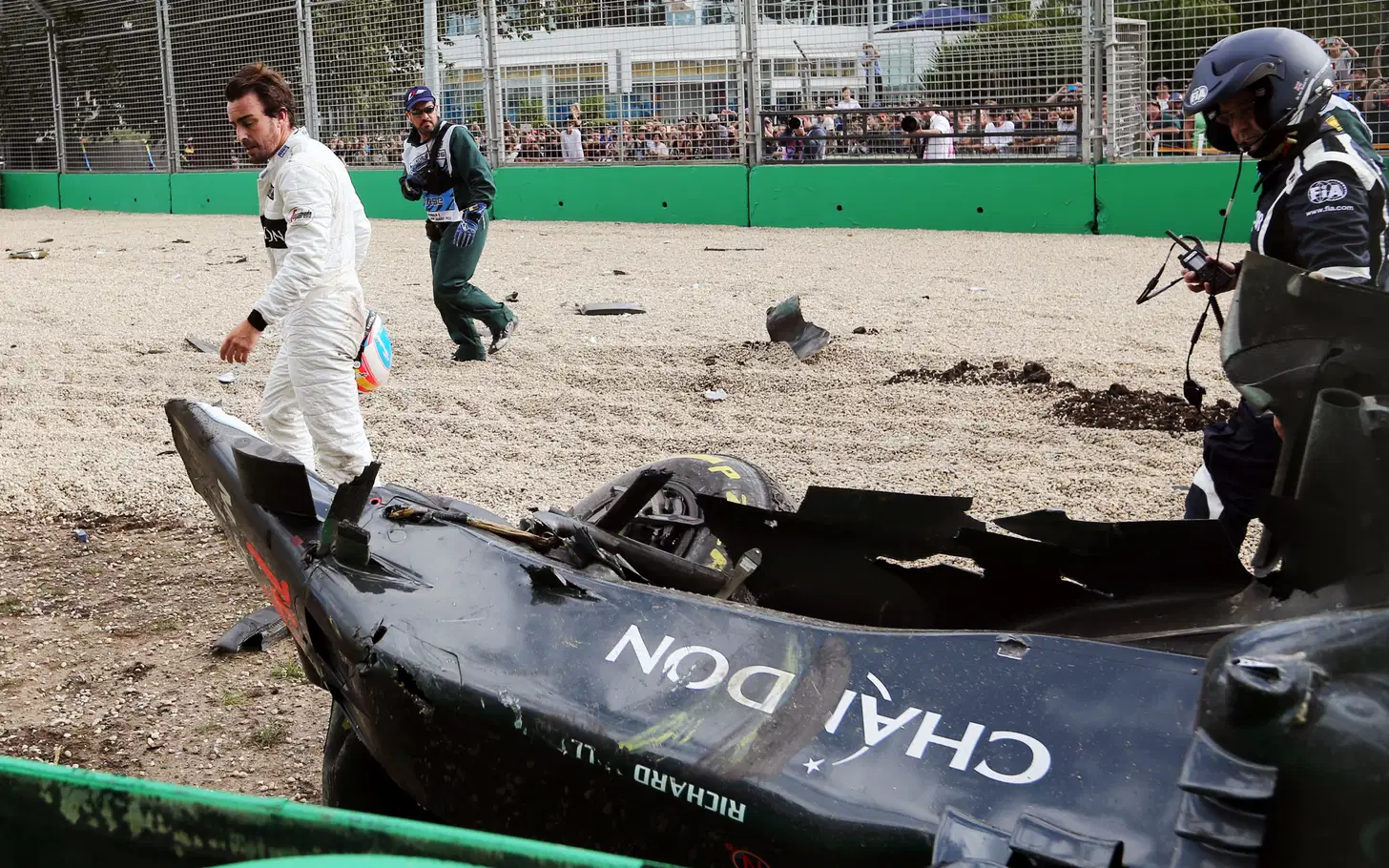

Formula 1, Sportrik Media - A decade has passed since Fernando Alonso was involved in one of the most dramatic accidents in modern Formula 1 history during the Australian Grand Prix in 2016.
The high-speed crash occurred on lap 18 of the season-opening race at Albert Park Circuit when Alonso, driving for McLaren, attempted to overtake Esteban Gutiérrez in the Haas F1 Team car approaching Turn 3.
As Alonso used the slipstream to move alongside the Haas before the braking zone, his reaction came slightly too late. The front-right wheel of the McLaren MP4-31 made contact with the left-rear tyre of Gutiérrez’s car at approximately 305 km/h.

The impact immediately sent Alonso’s car into the barriers at an angle that prevented the energy from dissipating effectively, producing a peak lateral deceleration of around 45G.
After rebounding off the wall, the damaged McLaren slid toward the gravel trap with three suspension corners destroyed. As the gravel caught the side of the car, it launched Alonso’s machine into a violent barrel roll.
The car rotated roughly 540 degrees and remained airborne for around 0.9 seconds before landing heavily on its rear crash structure, registering a peak longitudinal force of approximately 20G.
“You are just flying and then you see the sky, the ground, the sky, the ground and you don’t know,” Alonso said after the accident.
“Everything felt like it happened slower than it looked from the outside.”
Remarkably, Alonso managed to climb out of the overturned car and walk away from the crash. However, subsequent medical examinations revealed that the Spaniard had suffered fractured ribs and a collapsed lung.
The injuries forced him to miss the following race at the Bahrain Grand Prix, where Stoffel Vandoorne stepped in to make his Formula 1 debut as Alonso’s replacement.
Gutiérrez, who immediately ran toward the crash site to check on Alonso, later described the incident as “very, very scary.”
After reviewing the collision, the race stewards classified the accident as a racing incident, determining that neither driver was predominantly at fault.
Ten years on, Alonso’s dramatic Melbourne crash remains a powerful reminder of the safety advancements in Formula 1, highlighting how modern safety structures and regulations have helped protect drivers even in extremely high-speed accidents.
Baca Juga

Fermin Aldeguer sukses jalani operasi tangan kanan demi kejar tampil di GP Australia 2026. Baca analisis lengkap cedera dan perjuangannya di sini!
Simak analisis lengkap debut Max Verstappen di GT World Challenge Europe Portimao. Baca laporan kualifikasi selengkapnya di sini.

Mantan juara dunia F1 Nico Rosberg gandeng CYBEX sebaga duta keselamatan anak. Simak analisis lengkap, update produk S-Line, dan jadwal terkini di sini.
 Lanjutkan dengan Google
Diskusi & Komentar (0)
Mari Bergabung dalam Diskusi!
Masuk dengan mudah untuk mulai memberikan komentar, membalas, dan berinteraksi dengan pembaca lainnya.
Komentar Terbaru
Belum ada komentar. Jadilah yang pertama!