







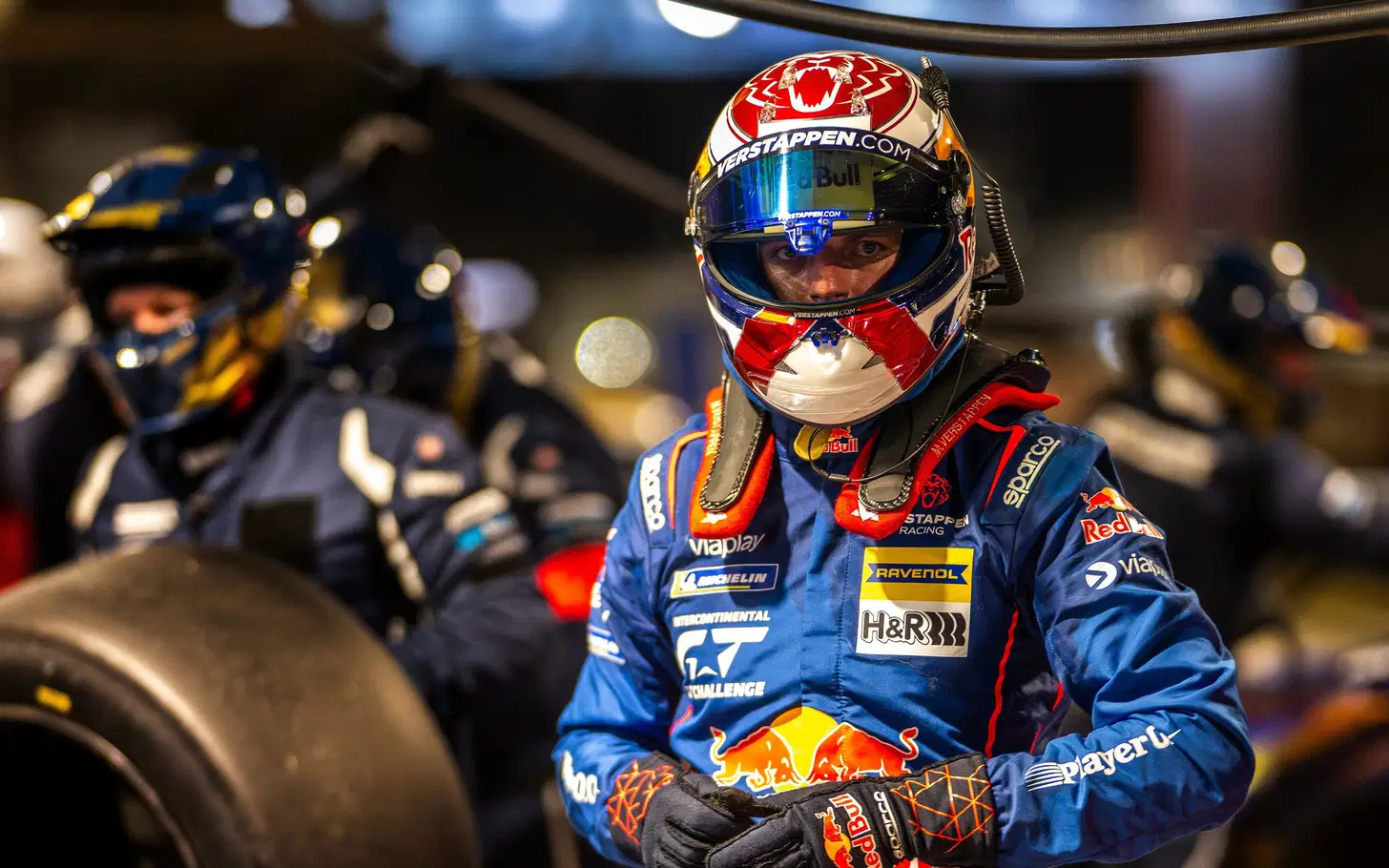

Motorsport, Sportrik Media - Max Verstappen reportedly pushed the development of his GT3 car far enough to leave Mercedes-AMG frustrated during his 2026 Nurburgring programme. According to endurance racer Renger van der Zande, Verstappen’s demands included searching for alternative suspension components to extract even the smallest possible performance gain from the car.
Van der Zande revealed the information after speaking to someone closely involved in Verstappen’s GT operation at the Nordschleife. That individual described the Dutch driver as someone who works to extremes when optimising personnel, technology and every component available. The approach indicates that Verstappen’s participation in GT racing is not merely a secondary activity outside Formula 1, but a competitive project being conducted to demanding technical standards.
“That person said, ‘He’s a freak. He goes to extremes to really squeeze every last bit out of people, technology and even the shock absorbers,’” Van der Zande told Ziggo Sport.
The disagreement with Mercedes-AMG reportedly emerged when Verstappen arrived with a box of shock absorbers obtained through a contact in France. He then requested that the components be used for racing, despite the manufacturer already having an established supplier and suspension configuration within its official technical package. In GT3 competition, such a change concerns more than driver preference because durability validation, damping characteristics, mechanical balance and component integration must all be considered.
“At one point, Max showed up with a box of shock absorbers he’d received from someone he knows in France. Then he said, ‘We’re going to race with these shock absorbers’. So AMG was totally pissed off because they didn’t want it,” Van der Zande explained.
Shock absorbers directly influence a car’s ability to maintain tyre contact with the track surface, particularly at the Nordschleife, where elevation changes, bumps, aggressive kerbs and high-speed corners create a severe mechanical challenge. Different damping characteristics can improve stability during compression and weight transfer, but an excessively aggressive configuration can reduce traction and accelerate tyre degradation. Verstappen’s interest in another solution therefore reflected his focus on mechanical grip and consistent performance across long stints.
The programme was operated by Verstappen Racing in cooperation with Winward Racing, using a Mercedes-AMG GT3. Verstappen shared the car with Lucas Auer, Jules Gounon and Daniel Juncadella at the 2026 Nurburgring 24 Hours. The number 3 entry demonstrated front-running speed and held the lead before suffering driveshaft damage shortly after Verstappen handed the car to Juncadella.
The retirement did not remove the evidence that the programme possessed the performance required to fight at the front. Verstappen had previously recorded an 8m11.614s lap in Top Qualifying 2, finishing only 0.191 seconds behind the session’s fastest time. During the race, he also had to manage multi-class traffic, changing weather, inconsistent grip and the balance between protecting the car and maintaining pace, all of which distinguish endurance competition from a Formula 1 sprint.
Van der Zande believes Verstappen’s working method mirrors the approach of his father, Jos Verstappen. He suggested Jos would also travel significant distances to obtain a karting component capable of producing only a marginal lap-time advantage. The comparison indicates that Max’s attention to technical detail did not develop only after his Formula 1 success, but came from a racing environment in which every potential performance gain was pursued.
“You could call Jos on a Friday during a karting weekend and say they had a carburettor in southern Italy that was half a tenth faster. Jos would then get in the car in the middle of the night to collect that carburettor. Max is just like that,” Van der Zande said.
The tension surrounding the component choice ultimately demonstrated the natural difference between a driver’s demands and a manufacturer’s technical process. Verstappen was seeking the response that best suited his requirements, while Mercedes-AMG had to protect reliability, homologation, supplier relationships and the consistency of its racing package. Following the mechanical retirement at the Nurburgring, the next phase will show whether Verstappen Racing and Mercedes-AMG can convert their demonstrated speed into a more complete endurance result.
Baca Juga
Komunitas balap historis Australia protes aturan Motorsport Australia yang melarang livery tembakau pada mobil legendaris. Mereka berjuang kembalikan pengecualian.
Elia Weiss dominan di F4 CEZ Brno dengan dua kemenangan, memperlebar jarak di klasemen. Jenzer Motorsport sapu bersih, persaingan juara memanas.
Indian Riders Fest 2027 resmi diumumkan, digelar 17-20 Juni di Lipno, Ceko. Nikmati aerodrom baru, rute rally, dan festival motor Indian terbesar.
 Lanjutkan dengan Google
Diskusi & Komentar (0)
Mari Bergabung dalam Diskusi!
Masuk dengan mudah untuk mulai memberikan komentar, membalas, dan berinteraksi dengan pembaca lainnya.
Komentar Terbaru
Belum ada komentar. Jadilah yang pertama!