







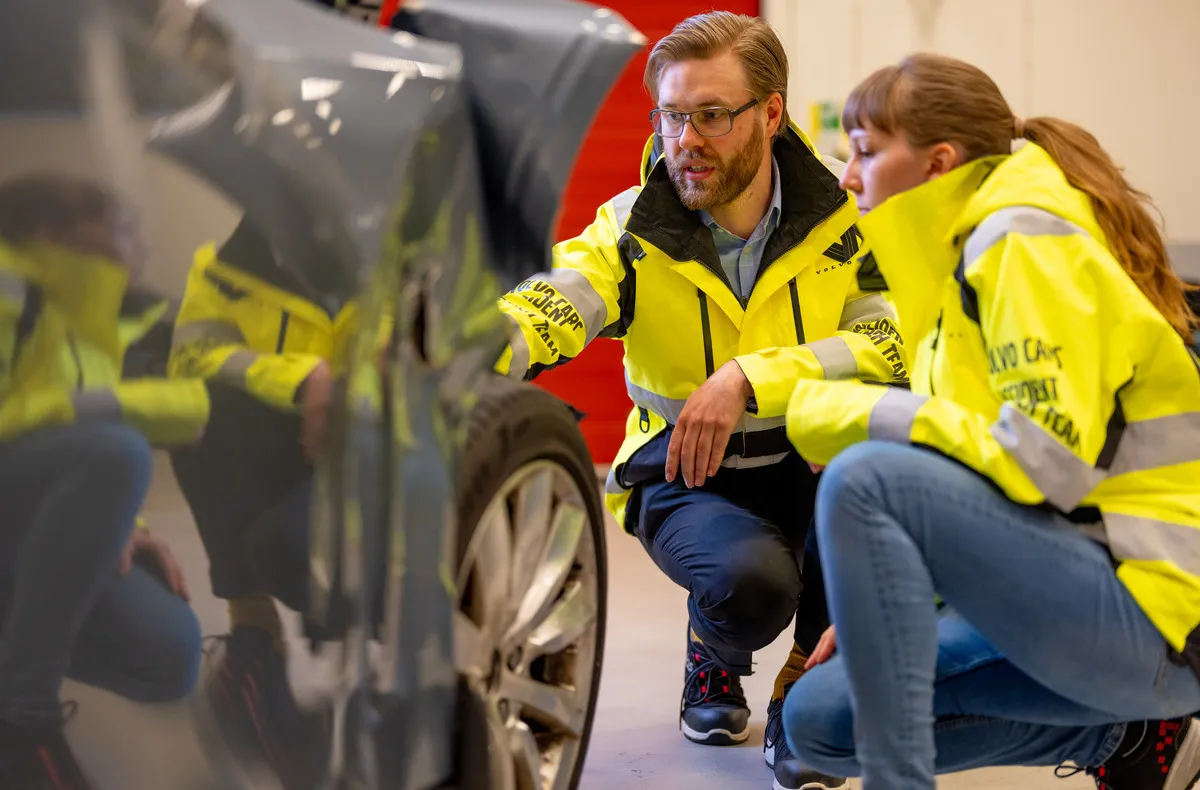

Swedish manufacturer Volvo has just published a groundbreaking report summarizing over five decades of real-world traffic accident investigations. Spearheaded by the company's dedicated safety center experts, this comprehensive study outlines how the evolution of automotive protective technology has drastically reduced injury rates for all motorists regardless of gender. The exhaustive data findings were officially presented during the international Enhance Safety of Vehicles conference for 2026.
Based on the technical breakdown prepared by safety center engineers Lotta Jakobsson and Thomas Broberg, a comparative analysis between vehicle lineups from the 1970s and the 2010-2019 decade reveals staggering progress. Overall, the total risk of injury for drivers has dropped by an impressive 79 percent thanks to continuous innovations in structural integrity, seatbelt engineering, and advanced crumple zones. This downward trend becomes even more pronounced when examining demographic safety improvements specifically for female motorists.
For female drivers, the injury risk reduction reaches an astonishing 88 percent across the analyzed generational models. This massive leap in protection successfully bridges historical safety gaps, bringing the injury risk profile for women down to a level closely comparable to that of male drivers. Furthermore, these empirical results effectively challenge long-standing assumptions that standard automotive cabin designs inherently offer differing levels of protection based purely on an occupant's biological sex.
The scope of the research extends far beyond the front row, highlighting major advancements in occupant protection across all seating positions within the vehicle. Evaluating diverse crash scenarios—including frontal impacts, side collisions, rollovers, and animal strikes—rear-seat passengers wearing seatbelts now benefit from protection levels that match or occasionally exceed those experienced by front-row occupants. The evaluation strictly focuses on occupants aged 13 and older, filtering out minor bruises to analyze moderate-to-severe life-threatening trauma such as bone fractures and concussions.
According to FormulaPassion, utilizing data derived strictly from real-world accidents allows engineers to continuously refine active and passive restraint systems. This rigorous, evidence-based approach ensures that modern vehicle architectures deliver uniform, high-standard protection for every single passenger on board, cementing a new benchmark for automotive safety moving forward into the future.
Read Also

Simak spesifikasi lengkap skuter penjelajah KYMCO CV-X45 2026 bermesin 427cc yang debut di EICMA. Baca analisis mendalam di sini!

Simak analisis mendalam perombakan komentator Supercars, aksi ciamik Richard Craill dan Garth Tander. Baca selengkapnya dan temukan update di sini!

Simak analisis lengkap kemarahan Fred Vasseur di F1 GP Singapura akibat drama Lewis Hamilton. Baca ulasan mendalam dinamika internal Ferrari di sini.
 Continue with Google
Discussion (0)
Join the Discussion!
Sign in easily to start commenting, replying, and interacting with other readers.
Latest Comments
No comments yet. Be the first!