







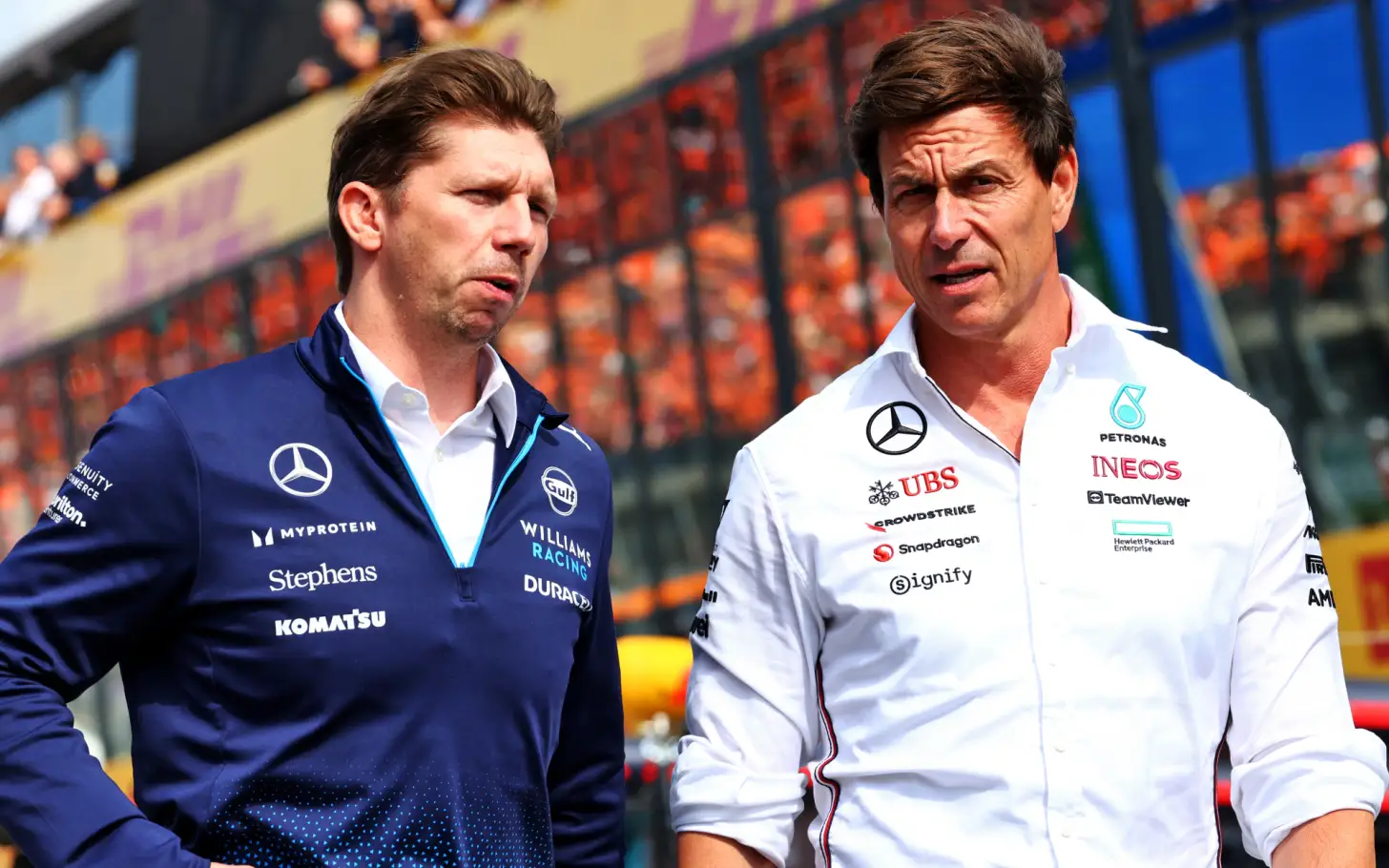

Formula 1, Sportrik Media - James Vowles has warned Formula 1 of “punishing” consequences if a late regulatory change is introduced to counter the alleged compression ratio advantage developed by Mercedes under the 2026 power unit rules.
Speaking during pre-season testing in Bahrain, the Williams team principal argued that altering the regulations at this stage would unjustly penalise not only Mercedes but also its customer teams, including McLaren and Alpine.
The dispute centres on Mercedes’ ability to achieve an effective 18:1 compression ratio when the engine is operating at high temperatures, despite regulations stipulating a maximum of 16:1 when measurements are taken under ambient conditions. The FIA has held multiple meetings with manufacturers in recent weeks in an effort to defuse tensions before the season opener in Melbourne on March 6–8.
In a worst-case scenario, all eight Mercedes-powered cars could face protests following the Australian Grand Prix, a situation the governing body is keen to avoid.
Mercedes maintains that its power unit is fully compliant and that it has been in constant dialogue with the FIA regarding its interpretation of the compression ratio regulations. According to the team, the solution represents years of engineering development rather than a last-minute loophole exploitation.
Vowles, who spent 13 seasons within Mercedes before taking his current role at Williams, emphasised the depth of work behind the project.
“They are incredibly good at regulation change, reading the rules exactly as they are, and pushing the boundaries of engineering,” Vowles said. “That is exactly what the power unit represents right now for Mercedes.”
He was firm in defending the legality of the unit currently installed in Williams’ car.
“My harsh line on it is that the PU we have in the car is completely compliant with the regulations. It is not a month of work, but several years of work to produce the PU to that level.”
Vowles stressed that Formula 1 is fundamentally a meritocratic championship, not a balance-of-performance series designed to equalise outcomes.
“We, as a sport, have to take care that this is not a BoP series. This is a meritocracy where the best engineering outcome effectively gets rewarded, not punished as a result,” he said.
While acknowledging frustration among rival manufacturers, Vowles cautioned against reacting in a way that undermines innovation.
“I’m sure other teams are upset that they weren’t able to achieve what Mercedes did, but we also need to take care,” he added. “My hope is that sense prevails and that we recognise we are here to reward innovation.”
He described the situation as increasingly political, with Mercedes defending its position and rival manufacturers such as Ferrari, Audi, and Honda pushing for clarification or regulatory tightening.
“There is pressure, but my line and Mercedes’ line are absolutely identical on this one great work by everyone across the last two years, not the last few months. That’s the result of what you have right now.”
The most severe concern, Vowles warned, would be a late rule change that effectively renders four teams non-compliant, potentially preventing eight cars from competing in Australia and possibly the following race in China.
“First of all, they have to come up with a regulation, and good luck with testing power units in the conditions you’re trying to replicate on track,” he said.
“The second element is what happens when you effectively change the rules so that, if we are not legal, there are eight cars not participating on the grid.”
He concluded by urging the sport to carefully consider the broader implications.
“We as a sport have to really think about what the implications of this change are.”
With the opening round approaching rapidly, the compression ratio controversy has become one of the defining off-track narratives of the new era. How the FIA resolves the matter may shape not only the competitive balance in 2026, but also the philosophical direction of Formula 1’s regulatory framework in the years ahead.
Baca Juga
Ferrari secara resmi membantah spekulasi masa depan Frederic Vasseur dan menegaskan fokus penuh pada sisa musim Formula 1 2025.

Mantan bos Ferrari Maurizio Arrivabene memperingatkan bahwa kedatangan Christian Horner bisa jadi bumerang. Simak analisis lengkapnya di sini.
Esteban Ocon sebut dirinya salah satu pembalap terbaik F1 usai finis kedelapan di GP Azerbaijan. Ia tegaskan tak takut mengatakannya meski masa depan di Haas belum pasti.
 Lanjutkan dengan Google
Diskusi & Komentar (0)
Mari Bergabung dalam Diskusi!
Masuk dengan mudah untuk mulai memberikan komentar, membalas, dan berinteraksi dengan pembaca lainnya.
Komentar Terbaru
Belum ada komentar. Jadilah yang pertama!