







MotoGP, Sportrik Media - The FIM MotoGP stewards panel, led by former grand prix rider and television analyst Simon Crafar, has published its official penalty protocol for the 2026 season, outlining in detail how on-track incidents, slow riding, start infringements and cross-event penalties will be judged.
Released ahead of the Thai Grand Prix at Buriram, the document formalises the philosophical framework behind stewarding decisions across MotoGP, Moto2 and Moto3. It reflects an effort to reinforce consistency, transparency and proportionality at a time when sprint races and increased competitive density have intensified scrutiny of race control decisions.
Slow Riding on the Racing Line: Zero Tolerance in Decisive Sessions
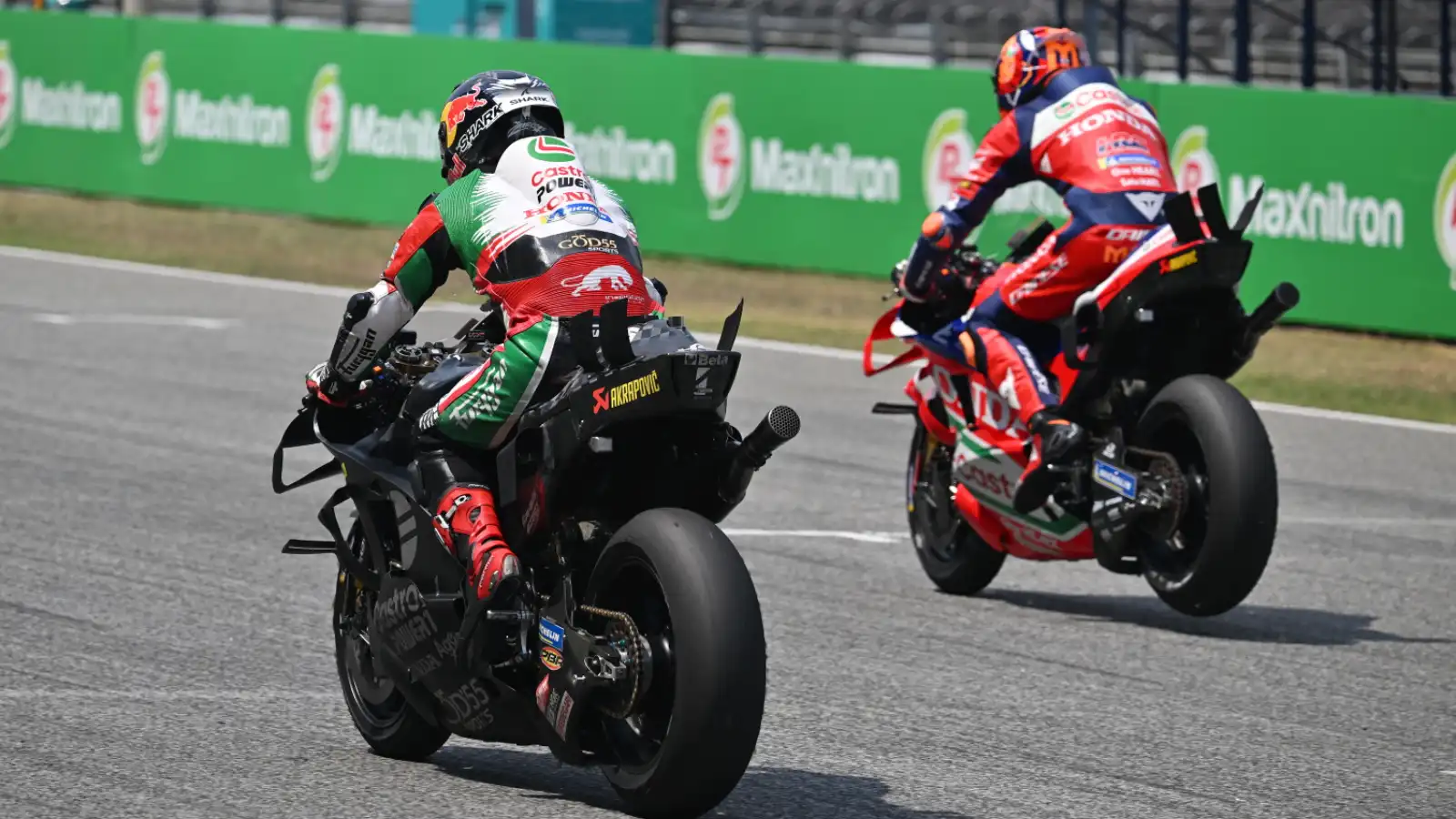
One of the clearest directives concerns slow riding on the racing line, particularly during critical qualifying phases. The stewards state that incidents in Q1 and Q2 that clearly disadvantage another rider will “almost always” result in a penalty, unless exceptional circumstances apply.
The same principle extends to the final 20 minutes of MotoGP Practice and the final 10 minutes in Moto2 and Moto3, given their influence on Q2 entry. Earlier practice sessions (FP1 and FP2) will be judged on a case-by-case basis, with initial warnings likely for first offences and escalating sanctions for repeat violations.
This approach reinforces competitive fairness in time-attack conditions, where a single compromised lap can define grid position and strategic direction. By differentiating between minor disruptions and significant performance impact, the panel seeks to ensure proportionality while maintaining deterrence.
Importantly, the document reiterates that not every incident requires steward intervention. Safety, fairness, consistency and common sense remain guiding principles, preserving discretion in borderline scenarios.
On-Track Incidents: Defining the Line Between Racing and Overreach
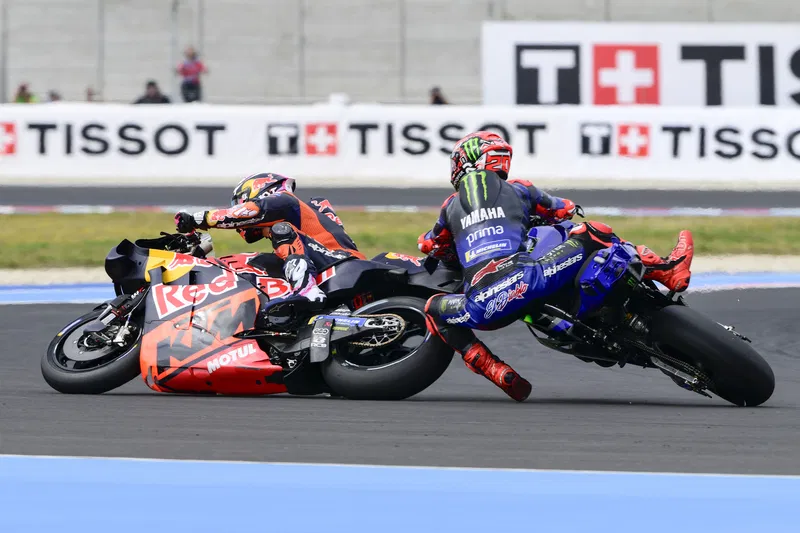
The protocol draws a clearer distinction between “racing incidents” and overly ambitious overtaking attempts. If an overtake is not deemed excessively aggressive, it will be classified as a racing incident with no penalty applied.
However, where contact becomes too forceful, or where positions are unfairly gained through excessive aggression, sanctions may follow. The severity escalates in line with consequences:
- Aggressive contact with limited impact → position penalty or long lap penalty.
- Taking another rider out of the race through an overly ambitious move → penalty.
- Strong collision with no realistic chance of a safe overtake → double long lap (MotoGP & Moto2), double long lap or pitlane start (Moto3).
The opening lap, particularly Turn 1, is treated with heightened severity. As a guideline, double long lap penalties will apply across all classes for significant first-lap incidents, with escalation for repeat offenders during the season.
This stricter early-race stance acknowledges the amplified risk of chain-reaction incidents when the field is tightly compressed.
Serving Penalties: Cross-Event Enforcement and Medical Independence
A key element of the 2026 protocol is the philosophy that penalties must be effective and served at the next championship event in which the rider participates — even if that occurs in a subsequent season.
However, if a rider misses the next event due to an unrelated injury or illness, the penalty is deemed served. This provision addresses past scenarios in which injured riders started races solely to clear sanctions, potentially compromising safety.
The document emphasises that medical decisions remain independent from disciplinary measures. The exception exists both to preserve rider welfare and to recognise that missing a race constitutes a more severe competitive consequence than, for example, a long lap penalty.
This structured yet pragmatic approach attempts to balance accountability with realism in the context of rider health.
Moto3: Stricter Sanctions for Developmental Reasons
The stewards explicitly state that Moto3 riders will receive more severe penalties for similar infractions compared to MotoGP and Moto2.
Two justifications are cited:
- Establishing behavioural standards for younger riders entering the paddock.
- The pack-racing nature of Moto3, where standard penalties may not sufficiently affect race outcomes.
Given Moto3’s frequent slipstream battles and dense group dynamics, lighter penalties often have limited strategic impact. Stronger sanctions are therefore intended to maintain deterrence and ensure consistent disciplinary weight across classes.
Sprint Races: Sunday Grand Prix Remains Primary
Despite the growing prominence of sprint races, the protocol reiterates that the Sunday Grand Prix remains the main event in MotoGP. Most disciplinary penalties will therefore be served in the Grand Prix rather than the sprint.
Exceptions apply to track limits violations, jump starts and technical infringements occurring during the sprint, which will be penalised within that race under existing FIM regulations.
This preserves the historical significance and competitive hierarchy of the Grand Prix while maintaining regulatory coherence across formats.
Strategic and Competitive Implications
The 2026 protocol represents a maturation of MotoGP stewarding under Crafar’s leadership. His tenure has generally been viewed positively by riders, particularly for improved communication and transparency.
By formalising escalation pathways for repeat offences, the panel introduces a cumulative risk factor into season-long behaviour. Riders who consistently operate at the edge may face progressively harsher consequences, especially in title-deciding phases.
The clearer definition of “overly ambitious” overtakes will be closely scrutinised in a field characterised by aggressive braking zones, sophisticated aerodynamics and narrow performance margins. With sprint weekends increasing total race laps and incident opportunities, consistency in interpretation will be critical.
Teams will likely recalibrate risk management strategies, particularly during race starts and high-stakes overtaking scenarios. Tactical aggression now carries not only immediate race consequences but also potential regulatory ramifications over the championship arc.
A Framework for a More Complex Era
As MotoGP continues to evolve with sprint formats, tighter grids and advanced technical packages, stewarding complexity increases in parallel. The 2026 penalty protocol seeks to deliver both clarity and flexibility — structured guidelines with room for contextual judgement.
Thailand will provide the first full-scale application of these updated principles. Over a 22-round season, their effectiveness will be measured not only in individual decisions but in overall competitive trust.
MotoGP 2026 therefore begins not only as a new sporting chapter, but as a regulatory one — where the balance between racing intensity and safety discipline is more precisely defined than ever.
Read Also
Simak pengakuan Alex Rins soal ancaman pembunuhan di Mandalika dan keluhan performa Yamaha. Baca analisis mendalam di sini!
Simak analisis lengkap tanggapan Michele Pirro soal rumor Maverick Vinales gabung Ducati. Baca selengkapnya dinamika test rider MotoGP di sini!
Raul Fernandez raih pole perdana MotoGP di Mandalika 2026. Simak analisis lengkap, sejarah rekor pembalap Spanyol, dan update berita terbaru di sini.
 Continue with Google
Discussion (0)
Join the Discussion!
Sign in easily to start commenting, replying, and interacting with other readers.
Latest Comments
No comments yet. Be the first!