







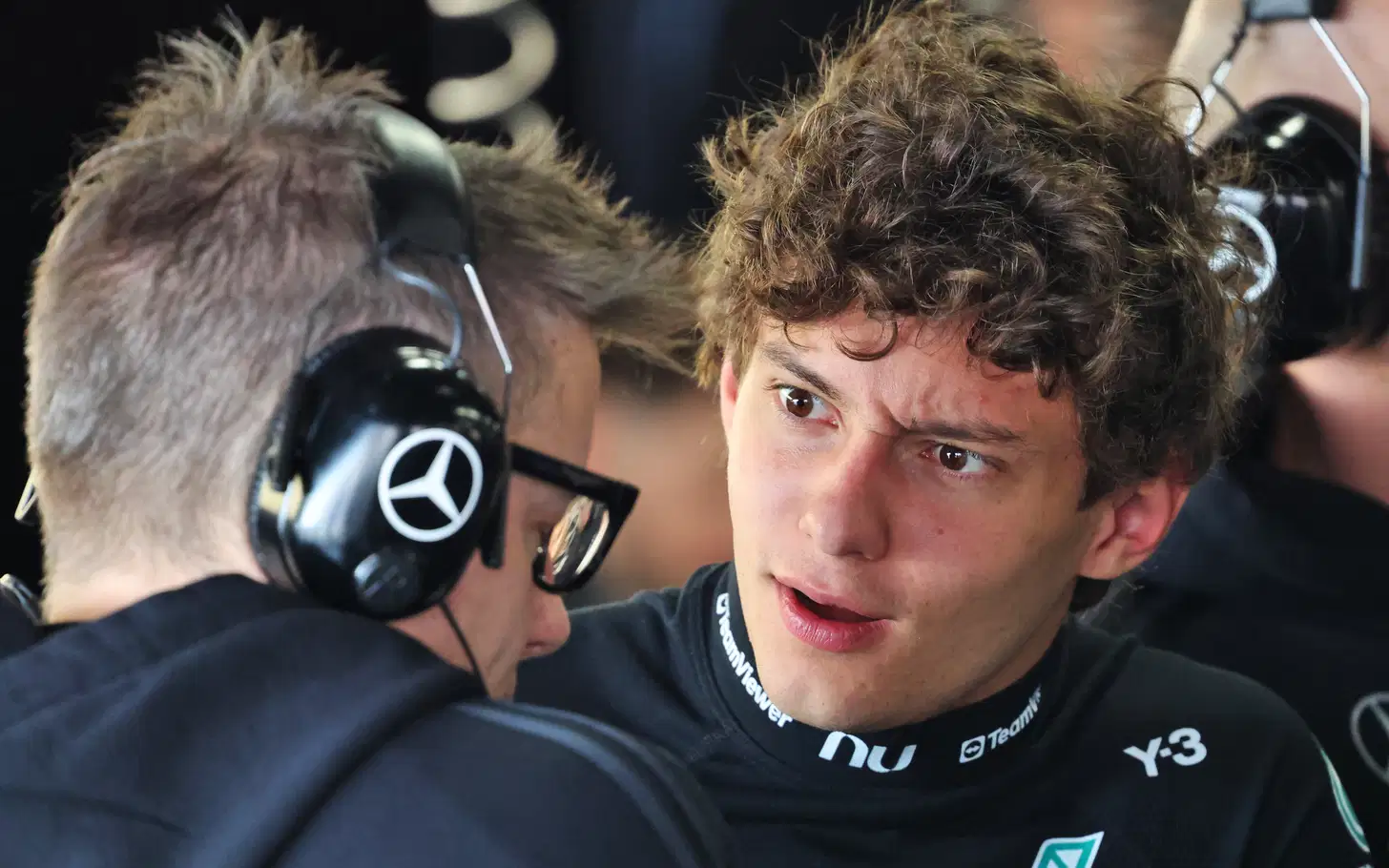

Kimi Antonelli has identified race starts as a key weakness for Mercedes-AMG F1 despite the team’s dominant form in the early phase of the 2026 Formula 1 season.
Mercedes has locked out the front row in all three opening grands prix in Australia, China, and Japan, underlining the raw pace of the W17 package. However, the team has consistently failed to convert those grid positions into race-leading track position, losing places on the run to Turn 1. This recurring pattern has exposed a vulnerability in the launch phase, forcing the team to recover through race pace and strategy.
From a technical perspective, start performance is heavily influenced by clutch bite-point calibration, torque delivery from the power unit, and traction control optimisation within regulatory limits. The W17 appears to struggle in initial traction stabilisation compared to rivals, suggesting that either the energy deployment mapping or rear tyre engagement is not as efficient during the critical first seconds of acceleration.

"I think our car is very good. For sure, maybe with the start," Antonelli said.
The issue was most visible in Japan, where Antonelli dropped from pole position to sixth after a poor getaway. While he accepted responsibility for that specific incident, he acknowledged that both he and George Russell have faced similar challenges since the start of the campaign.
"Japan was completely my fault. But together, me and George, we’ve been struggling a bit more than we would have anticipated since the start of the season," he explained.
Comparative analysis highlights McLaren as a reference point, particularly through Oscar Piastri, who demonstrated a significantly stronger launch phase. This indicates a combination of more refined system calibration and more precise driver input during clutch release and throttle application.
"McLaren got a really good start, so they’re clearly doing something better, also on driver input. In this case, Oscar did much better than me," Antonelli added.
In modern Formula 1, losing positions at the start has broader strategic implications. It increases exposure to turbulent air, compromises tyre management in the opening stint, and forces teams to adopt more aggressive strategies to regain track position. Although Mercedes has managed to recover through superior race pace, the inefficiency at the start introduces unnecessary risk into otherwise controlled race scenarios.
With the 2026 regulations still in an early development phase, marginal gains in areas such as launch performance can deliver decisive advantages. The Miami Grand Prix will serve as a critical test for Mercedes to address this weakness, particularly as rivals continue to close the gap through rapid development cycles.
Baca Juga

Kimi Antonelli menetapkan misi untuk terus belajar dan berkembang setelah memimpin klasemen F1 2026 dengan enam kemenangan dari 11 seri.

Aston Martin menyampaikan penghormatan kepada Mick Fern, teknisi ban yang dikenal sebagai Biscuit, setelah meninggal dunia dikelilingi keluarga.

Kimi Antonelli mengungkap kekhawatiran keselamatan membuat Mercedes membatalkan strategi satu pit stop pada Grand Prix Hungaria 2026.
 Lanjutkan dengan Google
Diskusi & Komentar (0)
Mari Bergabung dalam Diskusi!
Masuk dengan mudah untuk mulai memberikan komentar, membalas, dan berinteraksi dengan pembaca lainnya.
Komentar Terbaru
Belum ada komentar. Jadilah yang pertama!