





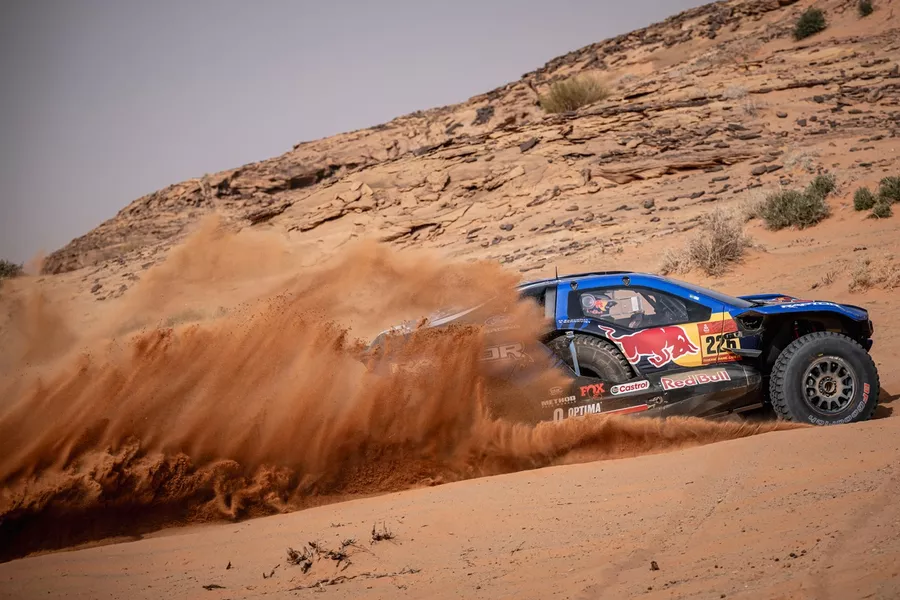
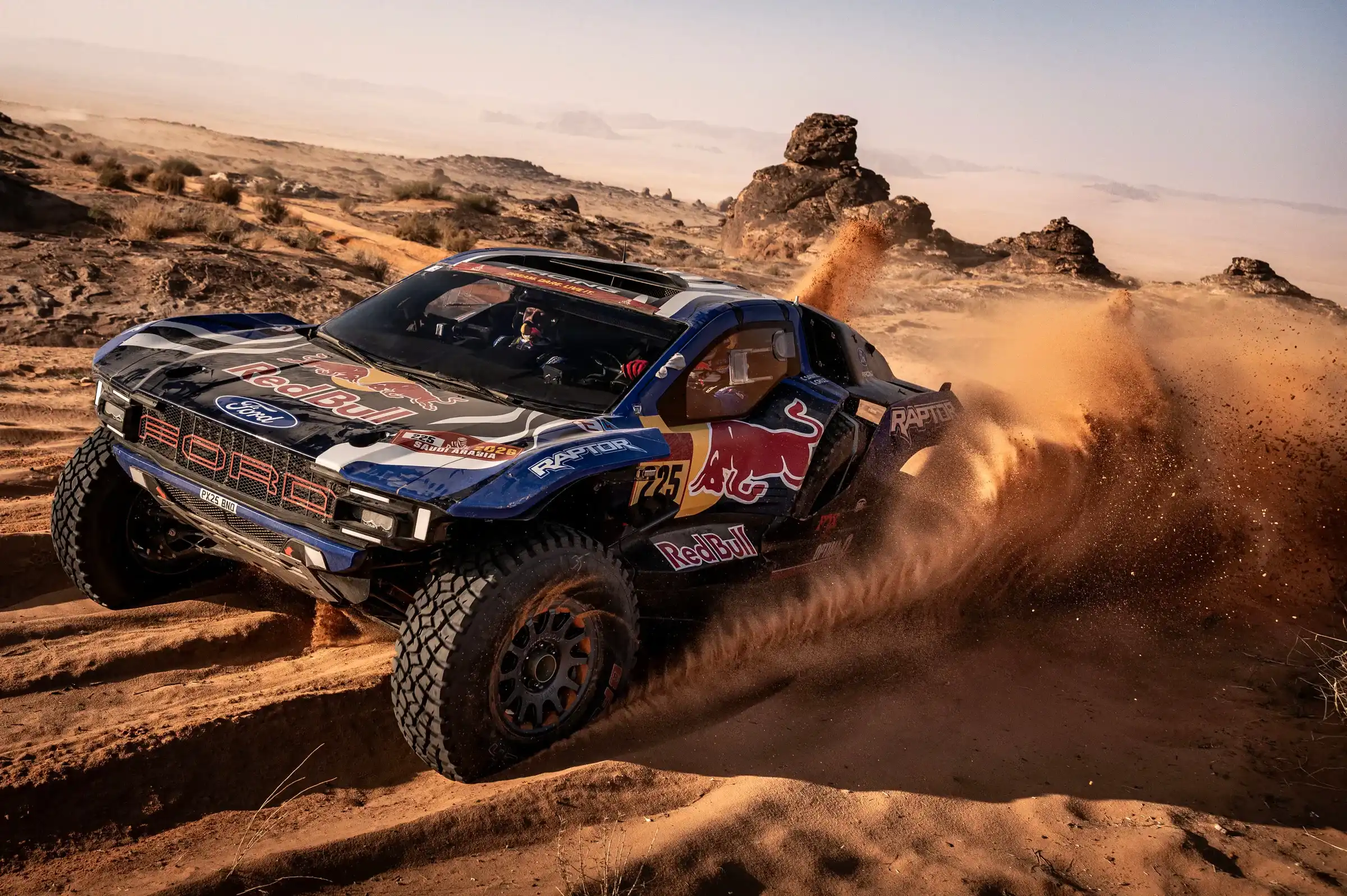
Dakar, Sportrik Media – In a field dominated by turbocharged power, the Ford Raptor T1+ stands out as the most radical technical statement at the Dakar Rally in 2026. While rivals such as Toyota Gazoo Racing and Dacia Sandriders rely on twin-turbo V6 engines, Ford has gone in the opposite direction with a naturally aspirated 5.0-litre V8.
It is a bold decision, but one rooted in Dakar’s harsh reality: endurance, heat and reliability matter more than peak horsepower.
The Coyote V8: Old School Power in a Modern Rulebook
At the heart of the Raptor T1+ is Ford’s 5.0-litre Coyote Darkhorse V8, a 32-valve engine with a 93mm bore and 92.7mm stroke. In unrestricted form it can produce around 500 horsepower, but under FIA torque-controlled T1+ regulations, all cars are capped by a mandatory torque curve and a top speed of 170km/h.
This means Ford’s naturally aspirated engine is no longer disadvantaged compared to smaller turbocharged units.
According to Joan Navarro, chief engineer at M-Sport Ford, the car was originally designed for a restrictor-based rule set, but the switch to a torque sensor actually played into the strengths of the V8.
Throttle response, drivability and durability all became competitive advantages.
Why No Turbo Is a Big Advantage at Dakar
Turbo engines generate huge heat loads. They require intercoolers, complex plumbing and boost control — all of which can fail in extreme desert conditions.
By using a naturally aspirated V8, Ford eliminates:
- Turbo lag
- Intercoolers
- Boost pressure spikes
- Extreme thermal stress
The result is a simpler, cooler and more robust powertrain, ideal for a rally where cars run at full throttle for hours through dunes, rocks and 50-degree heat.
Cooling Is the Real Battle
Dakar cars rarely exceed 80km/h in sand, yet they run at maximum power. That makes cooling far more important than aerodynamics.
Ford invested heavily in Computational Fluid Dynamics (CFD) to optimise airflow through the Raptor at low speeds, especially in dunes where airflow is minimal but energy demand is enormous.
This is where races are won or lost.
Fuel Efficiency of a Five-Litre V8?
Despite its size, the Coyote V8 is surprisingly efficient under the torque-limited regulations.
With output restricted to around 268–270kW (under 400hp), the engine is not stressed and therefore consumes less fuel than expected, allowing Ford to remain comfortably within the 500-litre fuel limit per stage.
Why Ford Chose Fox Over Reiger
In suspension, Ford again went its own way. While most rivals use Reiger dampers, Ford selected Fox, a company with deep roots in American desert racing.
Each wheel uses two independent Fox dampers, delivering improved traction, stability and control over whoops, rocks and dunes.
Testing proved they were not just different — they were faster.
2026 Focus: Lighter, Stronger, Faster
On its factory debut in 2025, Ford already won two stages and Mattias Ekstrom finished third overall.
For 2026, the priorities are clear:
- Reduce weight toward the 2,010kg minimum
- Fix reliability weak points
- Improve engine electronics and suspension
This is not a concept car anymore. This is a refined weapon.

Ford Is Built for Survival — and That Wins Dakar
Dakar is not about peak horsepower. It is about surviving 8,000km of mechanical torture.
With a naturally aspirated V8, Fox suspension and an obsessive focus on cooling and durability, the Ford Raptor T1+ is not just different — it is designed to thrive where others fail.
And in Dakar, that is how you win at https://sportrik.com/en.

Discussion (0)
Please login to join the discussion.
Latest Comments
No comments yet. Be the first!