








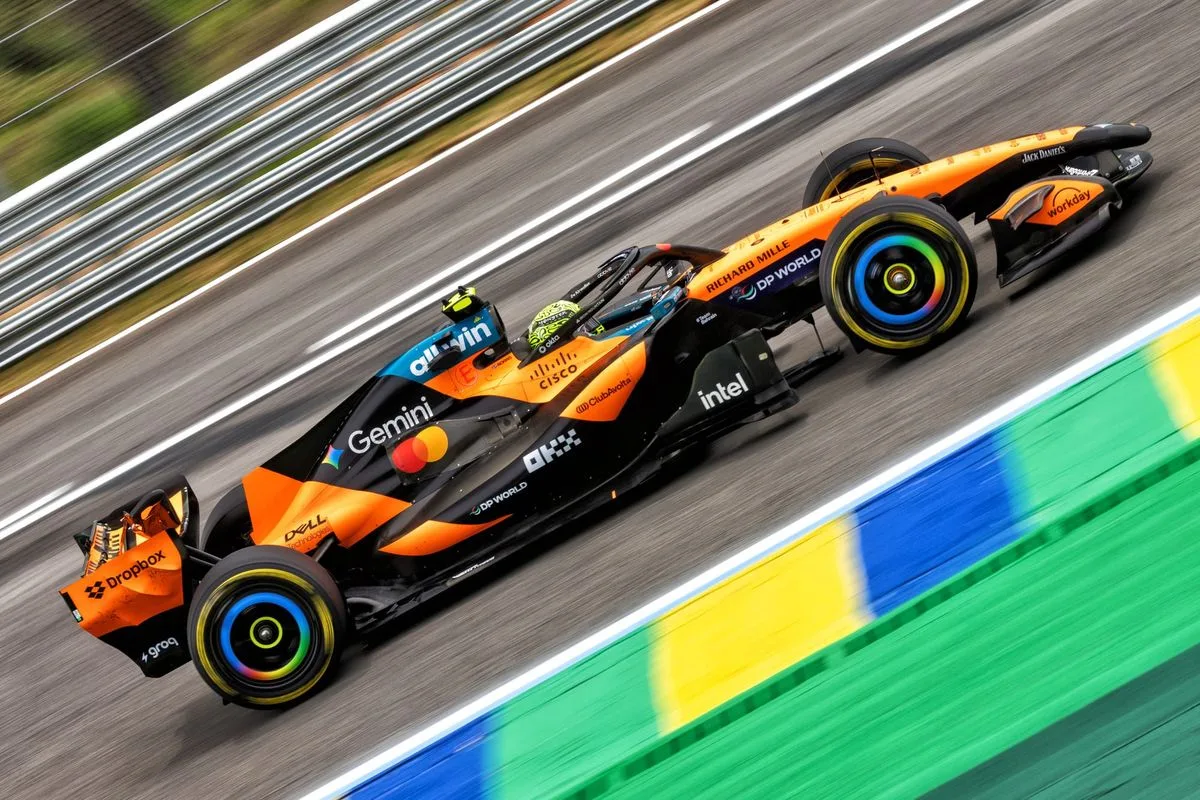
No team likes to air their dirty laundry in public, which makes McLaren labeling their newest front wing upgrade effectively as a 2027 concept rather peculiar. In such a position, expert analyst Gary Anderson argues that if track numbers and simulation tools show genuine potential, the team should utilize it immediately as a 2026 development asset.
With just a handful of races remaining before the winter break, maximizing track time to learn as much as possible from new aerodynamic components remains critical for any championship contender. The intersection between the mainplane and the lower foot of the endplate immediately catches the eye, adopting a philosophy similar to what Red Bull introduced earlier in the season.
By refining the single lower surface, the sensitivity of the endplate footplate to the track surface is greatly reduced, yielding more consistent downforce through high-speed corners. This reduces the snatchy behavior and ultimately enhances the overall stability of the rear end under heavy braking and cornering loads.
Adjustments to the slot gap profiles and flap angle reductions in straight-line versus cornering modes demonstrate the intricate compromises teams must make regarding aerodynamic efficiency and drag. These updates aim to address underlying balance struggles between low-speed agility and high-speed stability.
Read our in-depth technical analysis and stay ahead of the latest paddock developments by exploring our complete coverage right here.
Baca Juga

Simak analisis lengkap kemenangan spektakuler Brodie Kostecki di Sandown dan drama perebutan gelar juara musim ini. Baca ulasan mendalam di sini!
Simak analisis teknis mendalam Gary Anderson terkait pembaruan sayap depan kontroversial McLaren. Baca ulasan selengkapnya di sini.

Suzuki SV-7S resmi diumumkan dengan harga 7.199 euro di Spanyol membawa mesin V-Twin 73 CV dan teknologi modern. Baca analisis mendalam di sini.
 Lanjutkan dengan Google
Diskusi & Komentar (0)
Mari Bergabung dalam Diskusi!
Masuk dengan mudah untuk mulai memberikan komentar, membalas, dan berinteraksi dengan pembaca lainnya.
Komentar Terbaru
Belum ada komentar. Jadilah yang pertama!