







Formula 1, Sportrik Media - The technical landscape of Formula 1 2026 has begun to take shape during the opening Bahrain pre-season test, following the closed-door Barcelona shakedown, with several radical aerodynamic concepts immediately drawing attention across the paddock.
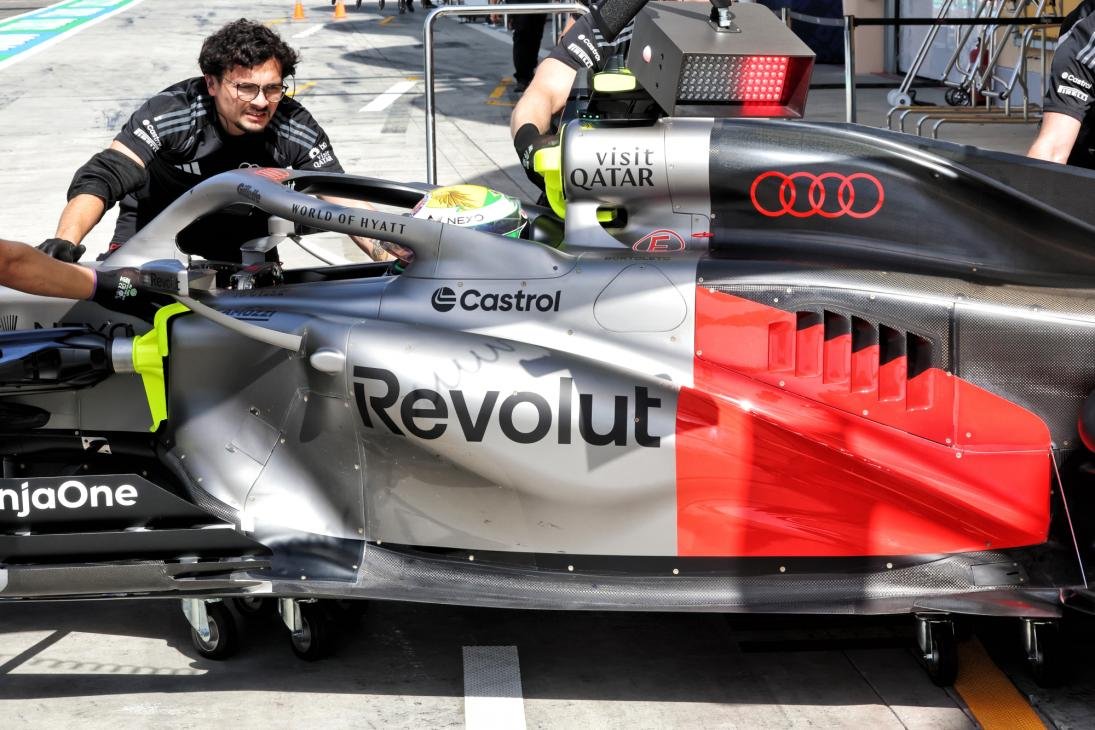
The most striking development belongs to Audi, which has introduced an unconventional sidepod configuration featuring vertical inlets reminiscent of the Ferrari 640 concept from the late 1980s. This approach fundamentally challenges the widely adopted undercut philosophy that has dominated recent aerodynamic thinking.
Contrary to first impressions, Audi’s solution does not reduce the frontal area of the sidepods. Instead, it increases it deliberately, with the objective of deflecting turbulent airflow outward and away from critical floor structures. This conceptual shift demands a radically different methodology for rear aerodynamic management, particularly in optimising airflow ahead of the front wheels and aft of the engine cover.
Audi’s aerodynamic measurement strategy further underlines the uniqueness of its design philosophy. While most teams deployed aero rakes behind the front wheels to analyse initial airflow characteristics, Audi positioned its rake ahead of the rear wheels. This placement reflects a primary focus on how air behaves after interacting with the vertical sidepod structures, highlighting the complexity of managing flow toward the diffuser.
Meanwhile, Aston Martin’s AMR26 has also attracted scrutiny, particularly due to its prominent engine cover air vent. The feature suggests extremely tight rear-end packaging and a highly sculpted body profile engineered to control airflow precisely toward the diffuser and rear wing assembly.
The Aston Martin concept demonstrates a distinct but equally aggressive philosophy, prioritising the controlled transition of airflow from the central bodywork toward the rear under active aerodynamic conditions.
Another area of notable divergence concerns rear flap operation under the new active aerodynamic overtake mode. Alpine has implemented a particularly distinctive mechanism in which the pivot point of the two movable rear wing elements is located at the centre rather than at the trailing edge.
This configuration lowers the trailing edge of the final flap instead of raising the leading edge of the first flap. The concept is linked directly to the team’s philosophy on managing diffuser air extraction on straights, particularly under diffuser stall conditions. The variety of solutions demonstrates how the 2026 active aero regulations have opened significant interpretative latitude among teams.
Beyond aerodynamic developments, the power unit discussion continues to shape the early narrative of the new season. A widely debated theory surrounding Mercedes focuses on compression ratio interpretation under the new engine rules.
All power units operate under identical regulatory parameters overseen by the FIA. However, speculation suggests that a particular compression ratio approach — legally measured under ambient inspection conditions — may result in different effective characteristics once the engine reaches full operating temperature on track.
Such an interpretation would not constitute a rule breach but rather a sophisticated exploitation of regulatory grey areas. Historically in Formula 1, however, these grey zones rarely remain open for long, often prompting clarification or technical directives once competitive implications become evident.
The 2026 Bahrain test therefore represents more than a routine data-gathering exercise. It marks the first visible manifestation of divergent aerodynamic and power unit philosophies that could shape the competitive hierarchy of the new era.
Audi’s radical sidepod concept, Aston Martin’s tightly packaged rear architecture, Alpine’s innovative rear flap mechanism, and the ongoing power unit discourse surrounding Mercedes collectively signal a regulation cycle rich in technical diversity.
As always in Formula 1, innovations that initially appear revolutionary may either redefine the standard or be curtailed by regulatory adjustment. With the season yet to begin, the 2026 era is already demonstrating the scale of conceptual reinvention underway at the highest level of motorsport.
Baca Juga
Lewis Hamilton menolak Sprint Race di Monaco untuk F1 2027, menyebut balapan di sirkuit sempit itu membosankan dan butuh format berbeda.
Masa depan Fred Vasseur di Ferrari dipertanyakan setelah performa buruk SF-26. Apakah Elkann dan Vigna harus memberi kepercayaan atau mengganti? Baca analisisnya.

Mercedes menang di Baku, Russell menekan Antonelli di F1 2026. Verstappen hampir menyalip, Ferrari terpuruk karena defisit tenaga mesin.
 Lanjutkan dengan Google
Diskusi & Komentar (0)
Mari Bergabung dalam Diskusi!
Masuk dengan mudah untuk mulai memberikan komentar, membalas, dan berinteraksi dengan pembaca lainnya.
Komentar Terbaru
Belum ada komentar. Jadilah yang pertama!