







The rear wing design has become one of the most critical innovations in Formula 1 2026. The new regulations allow the rear wing to switch between cornering and straightline modes, with the transition required to happen within 0.4 seconds. The goal is clear: maximum downforce in corners, minimum drag on straights. But behind the sophistication lies a technical challenge that can send drivers spinning.
Imagine you're blasting down a straight, then you hit the brakes. Instantly, the rear wing flap must close and the airflow has to reattach to the wing's undersurface as quickly as possible. If not, the rear of the car becomes unstable, especially during the initial braking phase. That's why the transition from straight mode to cornering mode happens automatically when the brake pedal is pressed, not via a button. Conversely, to open to straight mode, the driver presses a button, with no real urgency as the goal is simply to reduce drag.
Unfortunately, early this season showed the real risk. Twice Max Verstappen went off track on corner entry, specifically at the Red Bull Ring and Silverstone. The team later admitted that these incidents were caused by a mechanical problem with the active wing design. Such issues can escalate just by braking a metre or two later, increased turbulence, or a slight change in wind direction. Drivers are given the option to close the wing slightly earlier via a button, but the closing position becomes inconsistent and risky.

It's worth noting that the use of this system is not to improve overtaking, as every car activates straight mode on straight sections every lap. The main focus is achieving higher top speeds, especially when these cars—with hybrid regulations considered flawed—tend to run out of electrical power well before the end of the straights. With lower drag, acceleration and top speed become more efficient.
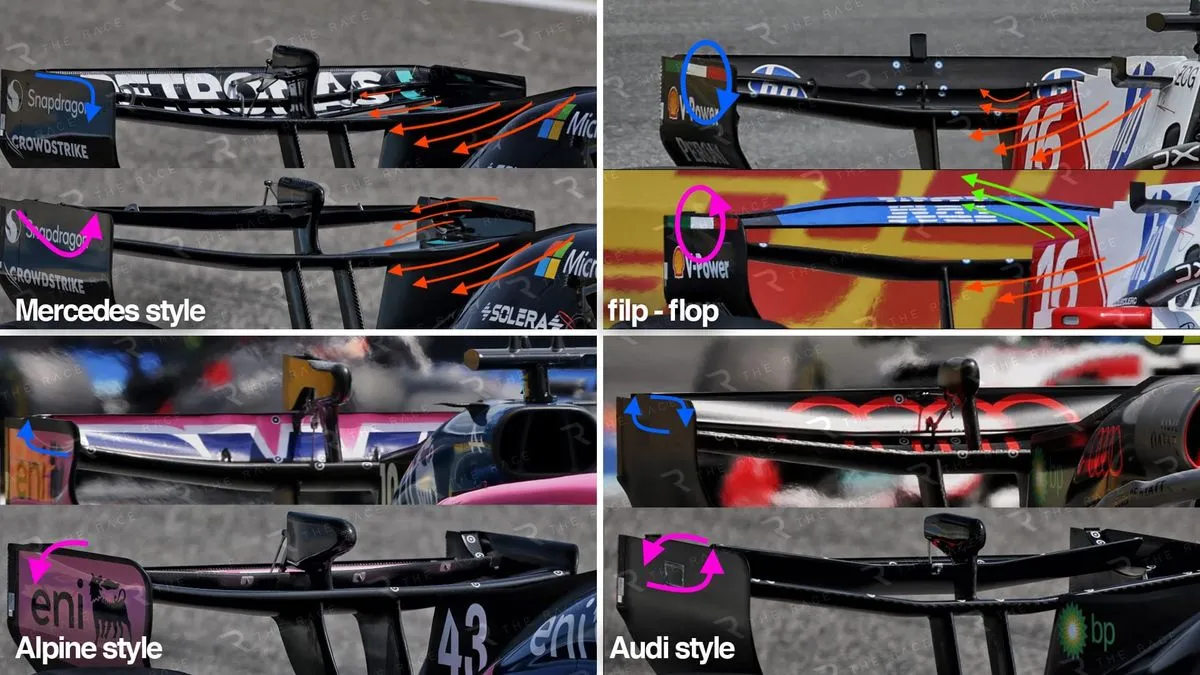
So what solutions have teams come up with? There are at least four main concepts, each with operational variations. The first concept is an extension of conventional DRS: the flap opens with a hinge at the leading edge, similar to DRS, but the opening size is not restricted by regulations so it can be as large as desired. The rotation direction when opening is shown by the magenta arrow, and when closing by the blue arrow. Not surprisingly, most teams chose this concept due to its familiarity.
In the Mercedes example, the difference in red-line thickness indicates areas of interest. Other concepts may use more complex designs, such as double flaps or translation mechanisms. Each team strives to balance reliability, aerodynamic efficiency, and regulatory compliance. One thing is certain: the active rear wing of F1 2026 is not just a trend, but a technological battlefield that could determine the champion.

With this complexity, engineers are required to continuously refine their designs. A small mistake can lead to incidents like Verstappen's. Therefore, it's no surprise that active rear wing development has become a top priority in each team's factory throughout the season.
Baca Juga
Pelajari cara kerja rear wing aktif F1 2026: mode cornering dan straightline, transisi 0,4 detik, serta empat konsep utama yang digunakan tim.
Istanbul Park bersiap kembalinya F1 2027 dengan renovasi paddock, peningkatan pengalaman penggemar, dan perbaikan infrastruktur. Simak detailnya!

Nico Rosberg kritik pedas Williams yang sebut musim 2026 sebagai 'shocker'. Tim terpuruk di peringkat 9 dengan hanya 11 poin. Apa penyebabnya?
 Lanjutkan dengan Google
Diskusi & Komentar (0)
Mari Bergabung dalam Diskusi!
Masuk dengan mudah untuk mulai memberikan komentar, membalas, dan berinteraksi dengan pembaca lainnya.
Komentar Terbaru
Belum ada komentar. Jadilah yang pertama!